
It’s not hard to grasp.
When a company profits from Canadian consumers, we expect economic activity to flow back into the country. A foreign business opening in Canada usually creates jobs, pays taxes, and contributes to the economy.
Foreign streamers are different.
Giants such as Netflix, Disney+ and Prime Video have full access to Canadian audiences, despite most of their programming being produced elsewhere. Entertainment aside, so little of what they offer directly benefits Canadian culture, so what are we getting in return for free access to our vast audiences?
ACTRA believes that platforms profiting handsomely in our market must give back to grow our domestic industry. If you value our business, then value our country by investing in Canada to be more than just a convenient place to sell content.
Critics say it’s simply the price of doing business. But is that true? Must we resign ourselves to their new model? France would reply with a strong “non.”
“In Canada, that has somehow become a political hot potato.”
Those very same streaming services operating in France have investment obligations tied to their French revenues, some as high as 25%. Yet Netflix, Disney+ and Prime are still there, surviving and thriving without astronomical subscription increases. The market determines those, not fearmongering studio lobbyists.
Canada does not need to copy France to the letter, but its system debunks the idea that meaningful cultural re-investment is incompatible with a healthy streaming market. In Canada, that has somehow become a political hot potato.
So how did we end up here?
In 2023, Parliament passed the Online Streaming Act, modernizing the outdated Broadcasting Act drafted in the 1990s.
In 2024, in efforts to operationalize the Act, the CRTC established a 5% base contribution obligation for foreign streamers operating in Canada. While some made initial payments, many challenged the requirement’s legality, with several cases remaining unresolved.
Fast-forward to May 2026. The CRTC went further, announcing that streamers must devote 15% of Canadian revenues to domestic programming expenditures. Simply put – more money to produce Canadian programming.
After years of debate, Canada seemingly had a framework recognizing the impact of streamers and establishing financial obligations into their business model.
Then the finish line moved.
Two weeks later, the federal government announced $600 million a year in new support for Canada’s audio and audiovisual sectors, directing the CRTC to review its framework rather than proceeding with the 15% plan.
“Surely, they wouldn’t replace streamer obligations with taxpayer money.”
Our industry was confused. Was this additional funding? Surely, they wouldn’t replace streamer obligations with taxpayer money.
Unfortunately, that was the plan. The government reasoned it was about “affordability,” warning that regulatory costs would be passed on to Canadian consumers.
(Now find me a single Canadian who believes subscription fees won’t keep rising.)
On July 17, government counsel confirmed fears, indicating to the Federal Court of Appeal that Ottawa was also eliminating the original 5% base contribution, with public funding as its substitute.
However, it was the timing of these sudden moves that raised eyebrows. These mandates appeared on the cusp of CUSMA bargaining with the United States, who had been loudly calling our cultural frameworks a “trade irritant.”
“Had culture become a pawn in international trade?”
That raised the question: “Had culture become a pawn in international trade?”
We may never know the inner workings of those negotiations, but any appeasement letting American streamers off the hook did nothing to bring about a deal. The fallout from the breakdown in negotiations and subsequent increase in American trade aggression has galvanized Canadians around protecting our nation – including culture – which hopefully gives the government an opportunity to course-correct.
The issue isn’t whether governments should support Canadian culture. Of course they should. It’s whether a sustainable cultural industry should depend only on public funds, while enormously profitable companies are getting away with contributing little.
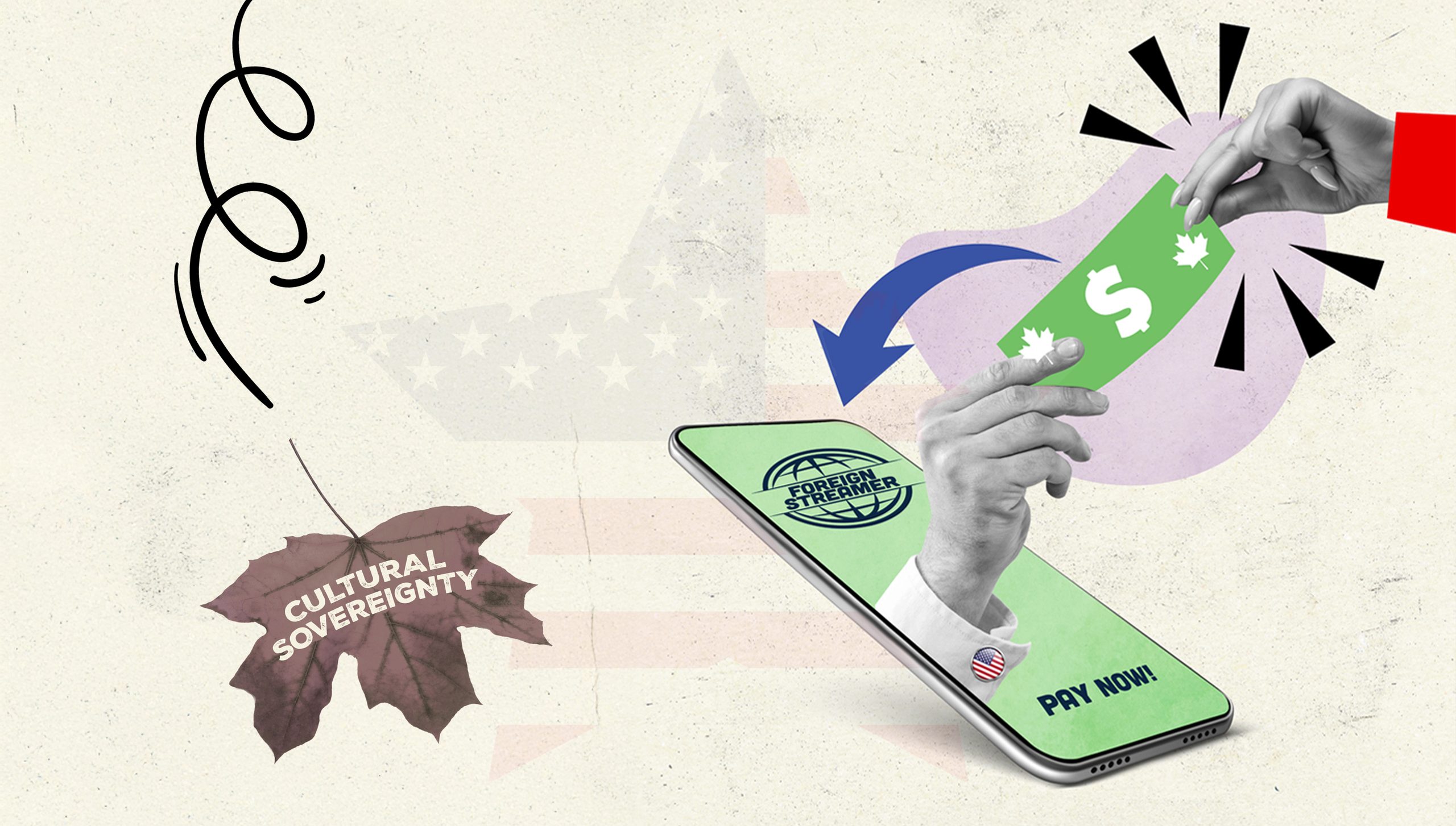
The $600 million fund sounds good on paper. In practice, its vague targets are not as reassuring. No cultural organization will refuse funding, but exactly how the fund is applied and who receives it, is far from resolved. Estimates put the amount remaining for new investment – after replacing pre-existing commitments – as low as $180 million.
More worrying, public funding is forever at the whim of a finance minister’s pen or a new government that doesn’t value culture as investment-worthy. It could simply disappear.
Codified foreign streamer obligations, however, can withstand political changes. And funding predictability matters.
“For performers, these aren’t policy scuffles.”
Canadian production cannot build long-term strategies around what a future federal budget might decide. Neither can a performer planning their career.
For performers, these aren’t policy scuffles. They determine whether productions get financed. Whether a Canadian series goes from script to set. Whether there is another audition, another day on set, another Canadian story for audiences to discover.
Whether performers can build sustainable careers at home.
That is why cultural sovereignty matters.
If decisions about which stories get made, who funds them and where the money goes only caters to studio heads’ pockets, Canada risks becoming a location shoot for making others’ culture rather than ours.
We must continue attracting foreign production with competitive tax credits and similar initiatives to bring investment and jobs for thousands of Canadians. Our performers and crews are highly sought after for good reason. Foreign production must remain an important part of our sector – but it cannot become the only part.
Foreign productions employ Canadians, but they rarely tell Canadian stories or contribute to funding Canadian content. Production happens here, but investing in our future is not a priority for foreign producers and streamers – unless we make them.
What is their priority? Our profitable audiences. And that’s leverage our government must use.
Cultural sovereignty means deciding that our stories matter and that those profiting from our nation have a responsibility to sustain its cultural survival.
“Our product is how we see ourselves as Canadians – past, present, and future.”
So, what’s next? Can the 15% benchmark rise from the dead? Will streamers face meaningful obligations? Will the annual $600-million fund provide the long-term certainty our domestic industry craves?
ACTRA believes Canada should not have to choose between public investment and streamer contributions. And we are not alone.
In addition to ACTRA National’s robust lobbying of the federal government, the union was a founding member of a coalition of 50 major organizations that called on the Prime Minister to enact predictable, enforceable contributions from streamers. Its ask was simple – enact the 15% benchmark to support a truly domestic industry that can thrive sustainably alongside – but not depend on – foreign service productions. Our $12 billion industry deserves the care and support offered to other “traditional” industries under threat. We have the most unique industry, and our product is how we see ourselves as Canadians – past, present, and future.
If streamers want to do business in Canada, it must be a two-way street. We cannot become a consumer vassal state.
If we lose our fight for a sustainable domestic industry, we aren’t only risking jobs – we risk losing a piece of ourselves.
After years of advocacy, the finish line keeps moving. ACTRA’s position does not.
It’s time to drag that line back north.